
Choosing a Coating System for Exterior Aluminum Coil: PE vs PVDF vs HDPE.
Three letters get thrown around in almost every coil coating conversation. They describe a real, well-documented tradeoff between how long a color holds and how tightly the coil can be formed, not marketing tiers.
Key takeaways
- PE, HDPE and PVDF sit on a rising scale of exterior durability and typical cost, in that order.
- PVDF generally holds color and gloss longest under UV and weather exposure; PE is the more economical, shorter-life option; HDPE sits between them.
- PVDF-class coatings are generally less flexible than polyester-class coatings, a real tradeoff against tight forming.
- AAMA 2605 is the recognized North American specification tier associated with 70% PVDF systems, useful context rather than an Orbit certification.
- Orbit's coating program covers PE, HDPE, PVDF, PU, PUPA, Epoxy, Acrylic and Epoxy-PE, with warranty 5 to 20 years by application and environment.
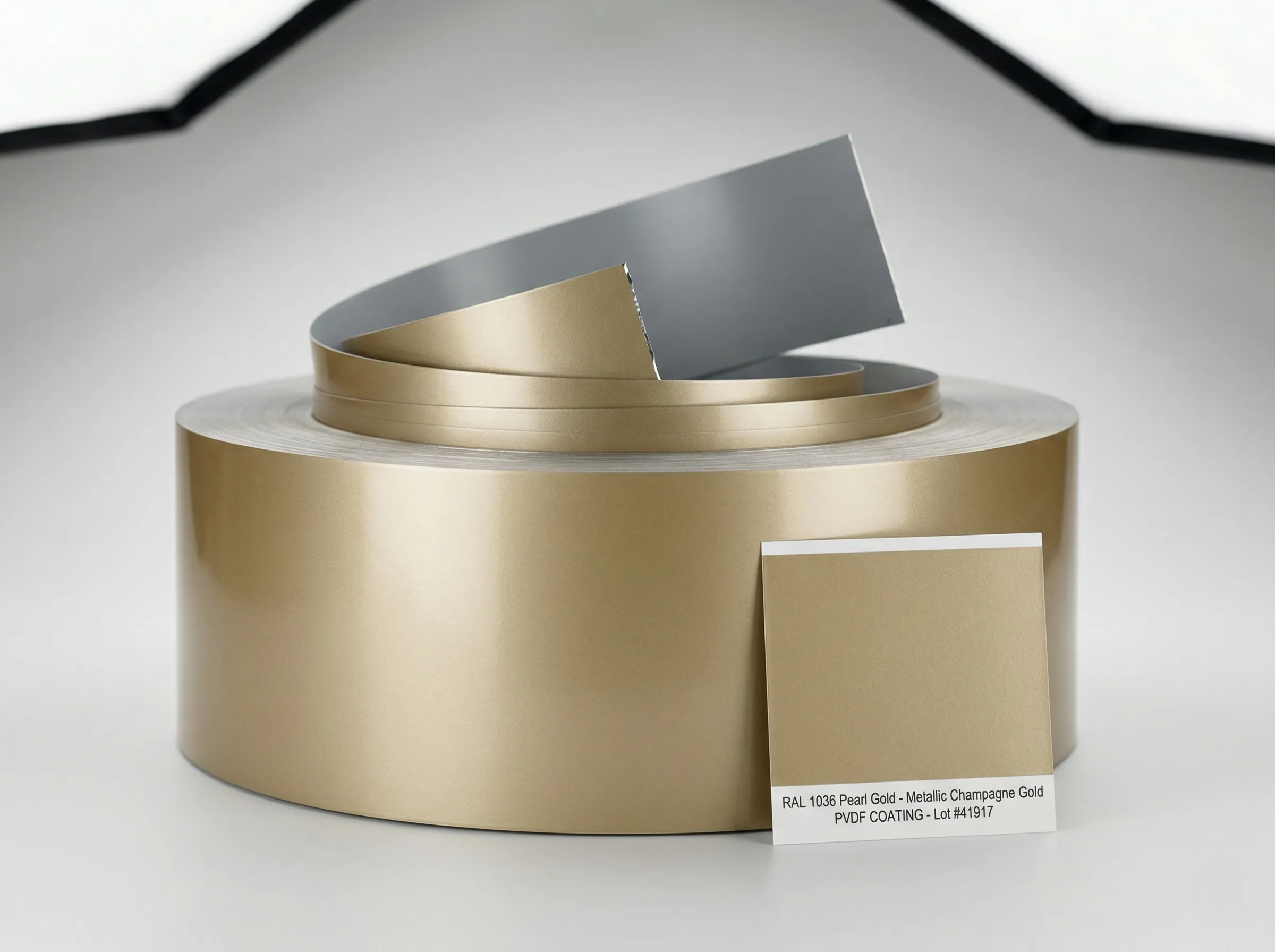
What's the actual chemistry difference between PE, HDPE and PVDF?
PE and HDPE are both polyester-family resins; PVDF is a fluoropolymer. Standard polyester and high-durability polyester share the same general resin backbone, built around carbon-hydrogen and carbon-oxygen bonds, while PVDF is built around carbon-fluorine bonds, among the strongest in organic chemistry.
That chemistry difference is the whole story behind the performance gap. HDPE improves on standard PE through modified resin formulation and better UV stabilizers within the same polyester family, rather than a different chemistry entirely. PVDF's fluoropolymer backbone is what gives it materially better long-term resistance to UV breakdown.
Which one lasts longest outdoors?
PVDF, generally by a wide margin. PVDF coatings are recognized industry-wide for holding color and gloss longer than polyester-family systems under sustained UV and weather exposure, with strong resistance to chalking, fading and chemical attack from pollutants and salt-laden air.
Standard PE is the more economical option and is more prone to chalk and fade under prolonged UV exposure, which is why it is generally positioned for interior, mild, or shorter-service exterior use. HDPE, as an upgraded polyester formulation, sits between the two: meaningfully better UV and color-retention performance than standard PE, without reaching PVDF's level.
Does that durability come at the cost of forming flexibility?
Yes, this is a genuine tradeoff, not a marketing distinction. Polyester-family coatings, including PE and HDPE, are generally formulated for higher formability, suited to deep drawing and tighter bends. PVDF-class coatings are generally less flexible, which is part of why some fabrication programs specify a polyester system specifically for a demanding forming operation even where PVDF's weathering performance would otherwise be preferred.
This is one of the reasons alloy, temper, gauge and coating system get specified together rather than the coating chosen last. A tight bend radius that works fine in an HDPE system can craze in a PVDF film if the forming operation was not accounted for when the coating was selected.
What is AAMA 2605, and does it matter for a coil order?
AAMA 2605 is the top tier of the American Architectural Manufacturers Association's three-part specification system for organic coatings on aluminum, associated with 70% PVDF fluoropolymer systems and used across the industry as a reference point for coatings expected to hold performance over a long exterior service life. AAMA is now part of the Fenestration and Glazing Industry Alliance, which maintains the specification today.
It is a useful specification to know by name when a project calls for "AAMA 2605-class" performance, since that phrase is shorthand for a specific, well-documented performance tier rather than a vague quality claim. To be clear about scope: this is industry reference context, not a claim that Orbit holds AAMA certification. Orbit's confirmed certifications are ISO 9001, ISO 14001 and ISO 45001.
How is color fade actually measured?
Through Delta E (ΔE), the standard industry method for quantifying color change on a coated panel over time, defined under ASTM D2244. A lower ΔE after a given exposure period means the color has drifted less from its original state.
Delta E is the common language a coatings technical datasheet or a specification uses to describe color retention, so it is worth knowing the term even if the specific pass/fail threshold for a given project is set by the specification you are working to rather than by the coil supplier.
Which system actually fits which exposure?
Moderate or sheltered environments generally suit PE, where the lower relative cost is not offset by much practical benefit from a higher-durability system. Higher-UV, coastal, or long-service-expectation environments generally favor HDPE or PVDF, in that order of increasing durability and typically increasing cost.
- PE. Economical, good formability, suited to sheltered exposure or shorter service expectations.
- HDPE. A more durable polyester system where exterior life needs to go further than standard PE, while keeping good formability.
- PVDF. The longest color and gloss retention under sustained UV and weather exposure, including coastal and architectural work, at the cost of somewhat lower forming flexibility.
Where do PU, PUPA, Epoxy, Acrylic and Epoxy-PE fit into this?
They cover needs beyond the PE, HDPE, PVDF exterior-durability scale. PU and PUPA (polyurethane and polyurethane-polyamide) are generally recognized for hardness and abrasion resistance, useful where a surface takes mechanical wear as well as weather. Epoxy, Acrylic and Epoxy-PE round out Orbit's program for applications with different priorities.
Which of these fits a given project depends on the specific combination of exposure, mechanical wear and forming the application involves, and we confirm that against your specification rather than defaulting to the exterior-durability trio above for every job.
How do PE, HDPE and PVDF compare at a glance?
| Characteristic | PE | HDPE | PVDF |
|---|---|---|---|
| Resin family | Polyester | Polyester (high-durability) | Fluoropolymer |
| Relative exterior durability | Lower | Moderate | Highest |
| Relative forming flexibility | Higher | Higher | Lower |
| Typical fit | Sheltered, shorter-service exterior | Extended exterior life over standard PE | Coastal, architectural, long service life |
| Orbit runs this system | Yes | Yes | Yes |
Orbit's coating program covers PE, HDPE, PVDF, PU, PUPA, Epoxy, Acrylic and Epoxy-PE, with finish options including solid, metallic, woodgrain, brushed, matte, gloss, textured, anti-graffiti and anti-bacterial variants, in RAL or custom colors. Warranties run 5 to 20 years depending on application and environment, confirmed against the specification. The National Coil Coating Association (NCCA) is the trade association representing coil coating businesses in North America.
Common questions
Is PVDF always the right choice for exterior coil?
Not always. It generally offers the best color and gloss retention, but it is also generally less flexible than polyester-class coatings, so a tight forming operation may favor PE or HDPE instead. We confirm the right system against both exposure and forming requirements.
What does AAMA 2605 mean on a specification?
It refers to the top tier of AAMA's organic coating specification system, associated with 70% PVDF fluoropolymer systems. It is industry reference terminology, not a certification Orbit holds; Orbit's confirmed certifications are ISO 9001, ISO 14001 and ISO 45001.
Is HDPE the same as HDPE plastic?
No. In coil coating, HDPE refers to a high-durability polyester coating formulation, not the high-density polyethylene plastic the same initials commonly refer to elsewhere.
What warranty applies to PVDF coated coil from Orbit?
Warranties run 5 to 20 years depending on application and environment. The figure applicable to a given project is confirmed against the specification, not quoted in advance of it.
Can I mix coating systems across one order?
Tell us the applications involved and we will confirm what is workable. Different parts of a single project sometimes call for different coating systems depending on exposure and forming requirements.
References
- Fenestration and Glazing Industry Alliance (FGIA): maintains the AAMA coating specification tiers, including AAMA 2605.
- National Coil Coating Association (NCCA): the trade association representing coil coating businesses in North America.
Not sure which coating system fits your project?
Send your application, environment, forming requirement and color. We will confirm the right coating system and respond within one business day.