
5052 vs 6061 Aluminum: Choosing the Right Alloy for Coil Coating.
Both alloys turn up in the same specifications, usually for different reasons. One is built to be formed and coated as supplied. The other is built to be heat treated for strength. Knowing which job a spec is actually asking for settles most of the confusion between them.
Key takeaways
- 5052 is non-heat-treatable and is generally less sensitive to a coil coating line's bake cycle than a heat-treatable alloy; 6061 is heat-treatable and generally the wrong product form for painted coil.
- Orbit's rolling program covers 1xxx, 3xxx and 5xxx alloys, not 6xxx, so a 6061 line item on a coil spec usually needs a second look.
- Welding disturbs 6061's T6 temper at the weld; 5052 has no such post-weld heat-treatment dependency.
- For outdoor cladding and roofing specifically, the real alloy choice is usually 3xxx vs 5xxx, not 5xxx vs 6xxx.
- Specific tensile and yield figures for either alloy are available on request against your temper and gauge.
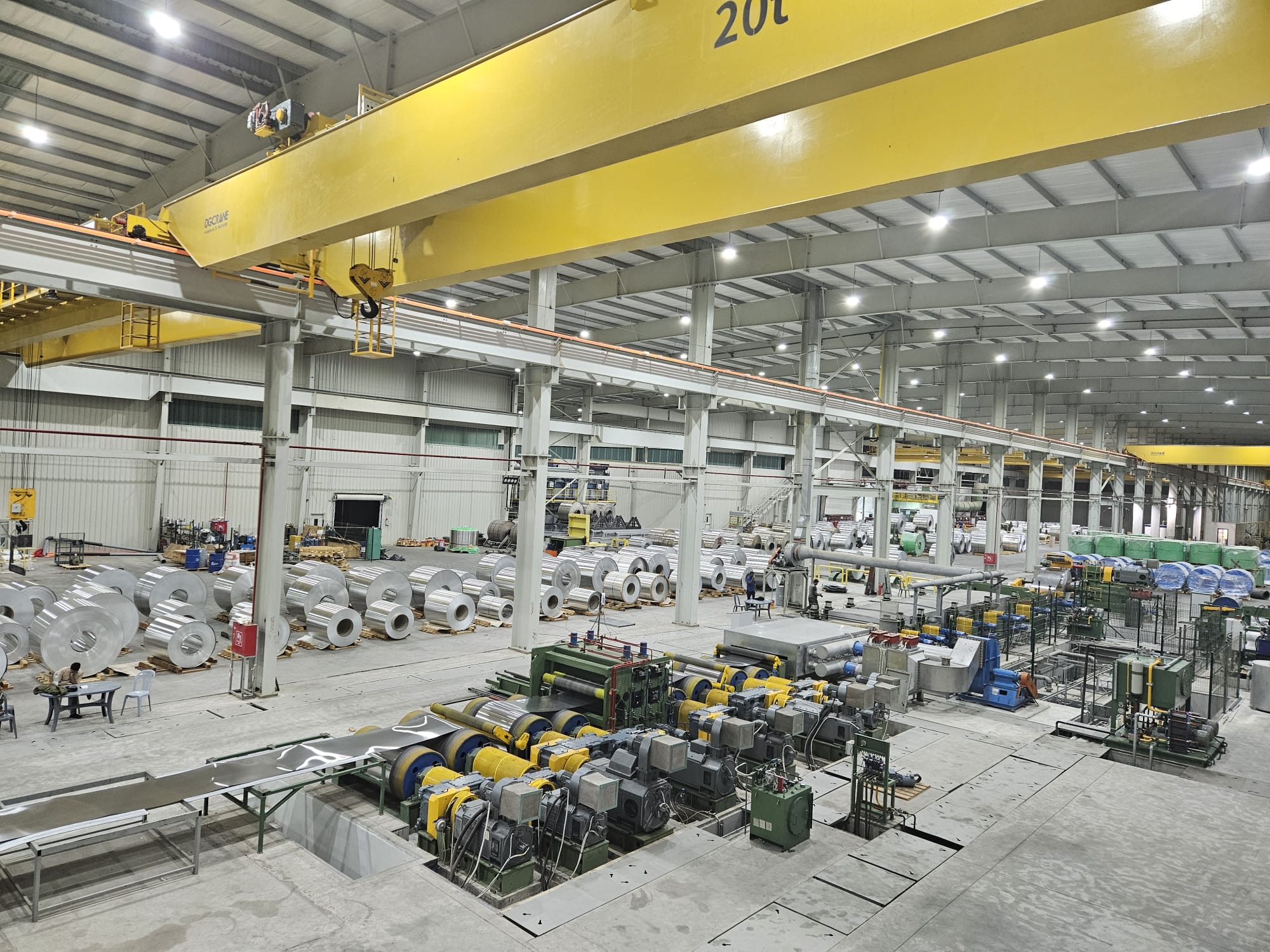
What's the actual difference between 5052 and 6061?
5052 is a non-heat-treatable 5xxx aluminum-magnesium alloy that gets its strength from cold work during rolling. 6061 is a heat-treatable 6xxx aluminum-magnesium-silicon alloy, solution heat treated and aged into a temper such as T6 to reach its designed strength. That one difference in metallurgy drives most of the practical gap between them.
5052 is supplied in H-series tempers that describe how much cold work has been applied. Both are registered, standardized designations rather than proprietary products, so the general characteristics here are published alloy behavior, not a claim about any one supplier's material.
Why does coil coating favor 5052 over 6061?
A coil coating line's bake cycle generally has far less effect on the strength of a non-heat-treatable alloy like 5052 than on a heat-treatable alloy, since 5052's strength was never set by heat in the first place, though the actual outcome still depends on the specific cycle. A heat-treatable alloy like 6061 is more sensitive to temper and thermal history through that same cycle, which is one more reason 5052 suits coil coating better than 6061.
This also reflects a broader product-form pattern: 6xxx and 7xxx alloys are used far more in extrusions, machined parts and structural framing than in coil form, while Orbit's own program rolls 1xxx, 3xxx and 5xxx for coated coil. It is a product-form pattern, not a statement about what any single mill can run.
Where does 6061 actually fit, if not coil coating?
6061 earns its place in extruded shapes, structural members and machined components, where heat treatment delivers strength a non-heat-treatable alloy cannot reach at the same weight. If a spec calls for painted 6061 sheet or coil, it is worth checking whether the requirement is really about structural strength.
If it is, a heat-treated 6xxx extrusion is likely the correct product form entirely, separate from the coated panel. If the alloy was simply carried over from a structural drawing out of habit, a coil coating conversation with the right alloy family is the more direct route. Orbit's rolling program covers 1xxx, 3xxx and 5xxx alloys, so a 6061 line item is a useful prompt to revisit which one the spec actually needs.
Does welding change which alloy you should pick?
Yes, for any project where the coil gets welded rather than only formed. 5052 welds well with common processes and does not depend on post-weld heat treatment, since it was never strengthened by heat in the first place. 6061 can also be welded, but welding locally disturbs its T6 temper in the heat-affected zone around the weld.
Recovering full T6 properties there generally requires a full post-weld heat treatment of the part. For a coil coating program, where panels are typically formed rather than welded, this matters less directly, but it is one more reason non-heat-treatable alloys suit coated sheet well: the properties they leave the mill with are the properties they keep through downstream processing, coating included.
What does 5052 actually offer a coil buyer?
5052 combines moderate strength for a non-heat-treatable alloy with good formability and the corrosion resistance generally associated with aluminum-magnesium chemistry, including in marine and coastal environments. It welds well, takes a wide range of finishes, and its H-series tempers give a predictable way to trade formability against strength.
See what the 1xxx, 3xxx and 5xxx numbers actually mean for how 5052 sits relative to the other series Orbit rolls. Specific tensile and yield figures for a given temper are available on request against your specification, since the applicable figure depends on gauge and temper together.
Can a project need both alloys at once?
Yes, and it is common rather than a mistake. Buildings and equipment that combine coated aluminum panels with structural aluminum framing often use 6061 extrusions or plate for the frame, where heat-treated strength earns its place, and 5xxx or 3xxx coated coil for the visible, weather-facing skin.
Confusion usually shows up when a single alloy callout gets copied across both scopes on a drawing. It is worth checking, item by item, whether each part is structural framing or coated cladding, and letting the alloy follow the product form rather than a single spec-wide default.
How do I resolve a 5052-vs-6061 line item on a spec?
Three questions usually settle it: is the part coil coated or heat treated and left mill finish, is the strength requirement structural enough to need a separate 6xxx extrusion, and was "6061" specified from familiarity with structural work rather than a genuine coil coating need.
- Coil coating points toward 5xxx or 3xxx; heat treatment and post-forming machining point toward 6xxx.
- A structural strength requirement may mean the correct product form is a separate 6xxx extrusion, not a painted panel at all.
- If "6061" was carried over from familiarity rather than a coil coating need, ask what performance the spec is actually after.
For outdoor cladding and roofing work specifically, see 3003 vs 5052 for outdoor coil coating.
How do 5052 and 6061 compare at a glance?
The table below lists general, source-verified characteristics only. It carries no numeric mechanical values beyond what is publicly documented for these standard alloy designations, and none of it is an Orbit-specific claim. The registered designations and chemical composition limits for both alloys are maintained by the Aluminum Association in its Teal Sheets alloy registration records, the reference most specifications point back to.
| Characteristic | 5052 | 6061 |
|---|---|---|
| Series | 5xxx, aluminum-magnesium | 6xxx, aluminum-magnesium-silicon |
| Heat treatment | Non-heat-treatable (strain hardened) | Heat-treatable (solution heat treated + aged, e.g. T6) |
| Typical temper family | O, H-series | T-series (e.g. T6) |
| Behavior in a coating bake cycle | Generally less sensitive to the bake cycle than a heat-treatable alloy | More sensitive to thermal history |
| Welding | Good weldability, no post-weld heat treatment needed | Weldable, but HAZ strength drops and generally needs post-weld heat treatment to recover T6 |
| Typical product form | Coil, sheet | Extrusions, structural shapes, machined parts |
| Orbit rolls this alloy | Yes | No (Orbit's program is 1xxx, 3xxx, 5xxx) |
Common questions
Does Orbit roll 6061 coil?
No. Orbit's rolling program covers 1xxx, 3xxx and 5xxx alloys. If a specification calls for 6061, it is worth checking whether the requirement is actually for coil coating, where 5052 is the closer fit, or for a heat-treated structural product Orbit does not produce.
Can 5052 replace 6061 on a drawing?
Only if the part does not actually need heat-treated strength. Where the requirement is genuinely structural, a 6xxx extrusion is the correct product form, separate from a coated panel. Where the part is a coated panel that was labeled 6061 out of habit, 5052 is usually the closer fit.
Is 5052 or 3003 the better fit for a coastal project?
5052 is generally favored for more demanding, marine-adjacent exposure. See our comparison of 3003 vs 5052 for outdoor coil coating for how to weigh environment against specification simplicity.
What temper and gauge should I specify for 5052 coil?
It depends on the forming operation and the strength the finished part needs to carry. Orbit rolls coil from 0.20 to 2.00 mm thick and up to 1650 mm wide, and we confirm the alloy, temper and gauge combination against your specification rather than a generic recommendation.
Does Orbit provide mechanical test data for 5052?
Specific tensile, yield and elongation figures for a given temper and gauge are available on request against your specification. Testing is to ASTM or EN depending on your market.
References
- Aluminum Association — Teal Sheets: registered alloy designations and chemical composition limits for 5052 and 6061.
Not sure which alloy your spec needs?
Send your application, forming requirement, gauge, coating and destination. We will confirm the right alloy family for a coil coating program and respond within one business day.